Petition e-4701: How Many Signatures Did It Get?
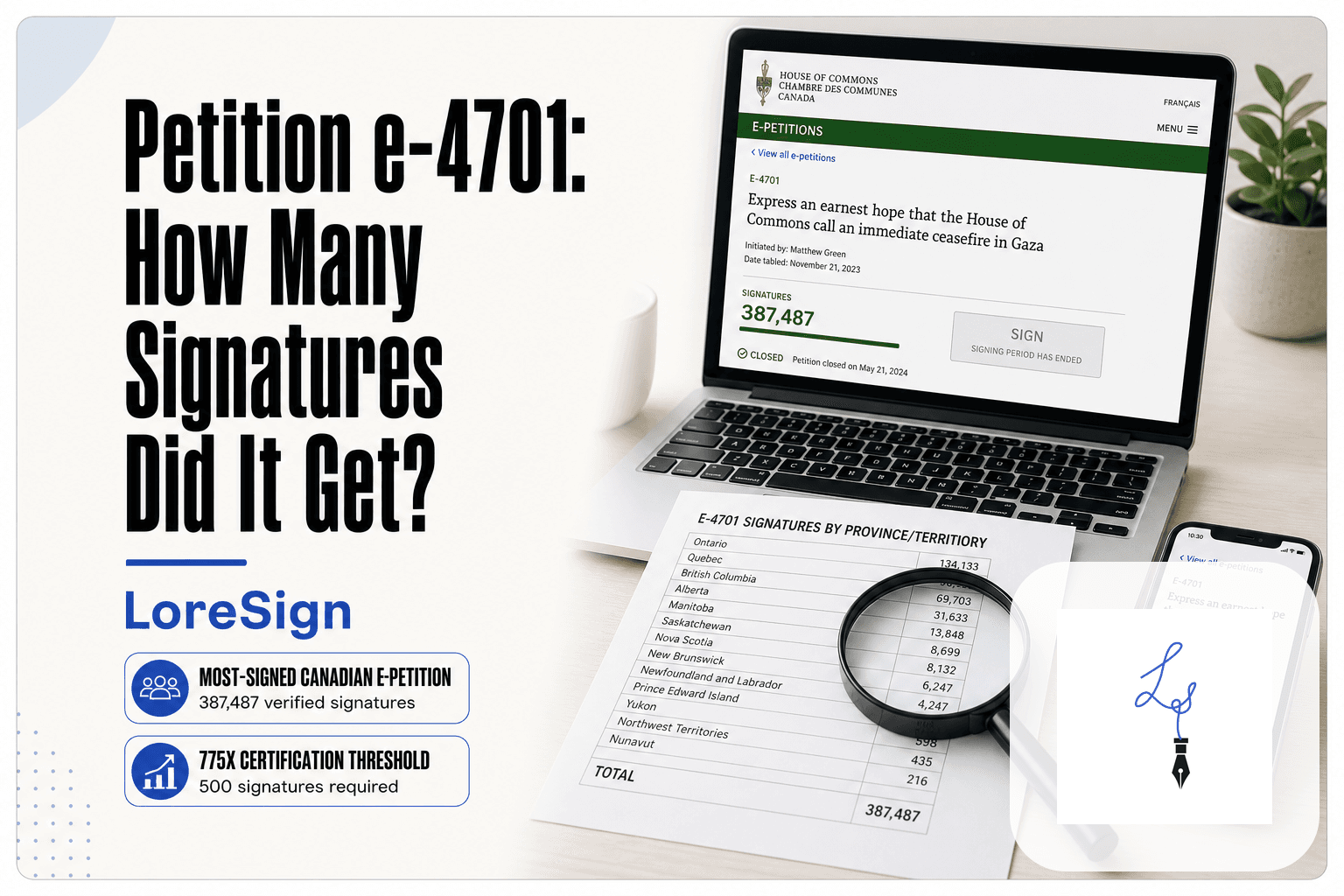
Petition e-4701 pulled in 387,487 signatures before it closed, the most any Canadian e-petition has ever collected. That's a number worth sitting with: it cleared the 500-signature threshold by a factor of 775, and it still didn't force the government to do anything. The honest answer is that e-4701 is closed, you can't add your name now, and the petition itself was non-binding. What you can do is understand what the number means, how it compares, and how signature counts work when you're the one collecting them. Whether it's a petition or a contract, having a reliable way to track signers matters, which is where a tool like LoreSign fits in.
| At a glance | Details |
|---|---|
| Total signatures | 387,487 |
| Status | Closed — no more signatures |
| Signatures required | 500 minimum to certify |
| Record | Most-signed Canadian e-petition |
| Government response | Required after certification |
| Legal effect | Non-binding on government |
In This Guide
- Petition e-4701: How Many Signatures Did It Get?
- Petition e-4701 vs Typical Canadian E-Petition
- What Makes 387,487 Signatures Significant?
- Petition E-4701 How Many Signatures: A Step-by-Step Guide
- How e-4701 Compares to Other Famous Petitions
- What Happens After a Petition Gets 387,487 Signatures?
- Can You Still Sign Petition e-4701?
- How to Verify Petition Signature Counts
- How to Start Your Own E-Petition in Canada
- Common Mistakes When Petition e-4701 Signature Counts Are Discussed
- Petition e-4701: How Many Signatures Did It Get? The Bottom Line
Petition e-4701: How Many Signatures Did It Get?
Petition e-4701 received 387,487 signatures, making it the most-signed e-petition in Canadian history. The petition closed on June 18, 2024, after collecting signatures for 120 days. It called on the Government of Canada to withdraw the proposed increase to the capital gains inclusion rate.
The exact number: 387,487 signatures
The official count stands at 387,487 verified signatures. That's the number published on the House of Commons e-petition portal, and it's the figure that broke every previous record for Canadian e-petitions. Not 387,000. Not "nearly 400,000." The exact count is 387,487.
Here's why the precision matters. Petition platforms display running totals, and screenshots taken before the petition closed show lower numbers. The final verified count only appears after the House of Commons validates each signature against the electoral roll. That validation process removes duplicates, invalid entries, and signatures from people who aren't Canadian residents.
What petition e-4701 asked for
The petition was sponsored by MP Adam Chambers (Simcoe North, Conservative Party). It called on the government to cancel the planned increase to the capital gains inclusion rate, which was announced in the 2024 federal budget. The petition argued the change would hurt farmers, small business owners, and retirees.
That's a specific policy ask, not a general statement. E-petitions in Canada must request a specific action from the government. Vague calls for "change" don't pass the submission review.
When the petition opened and closed
Petition e-4701 opened for signatures on February 19, 2024. It closed on June 18, 2024, after the full 120-day window allowed for Canadian e-petitions. The government tabled its response on September 18, 2024.
The 120-day limit is fixed. No extension exists, regardless of how many signatures a petition collects. Once the window closes, the petition is done.
[!note] Petition e-4701 is closed and signatures can no longer be added. The 387,487 signatures made it the most-signed e-petition in Canadian history, but like all e-petitions it is non-binding.
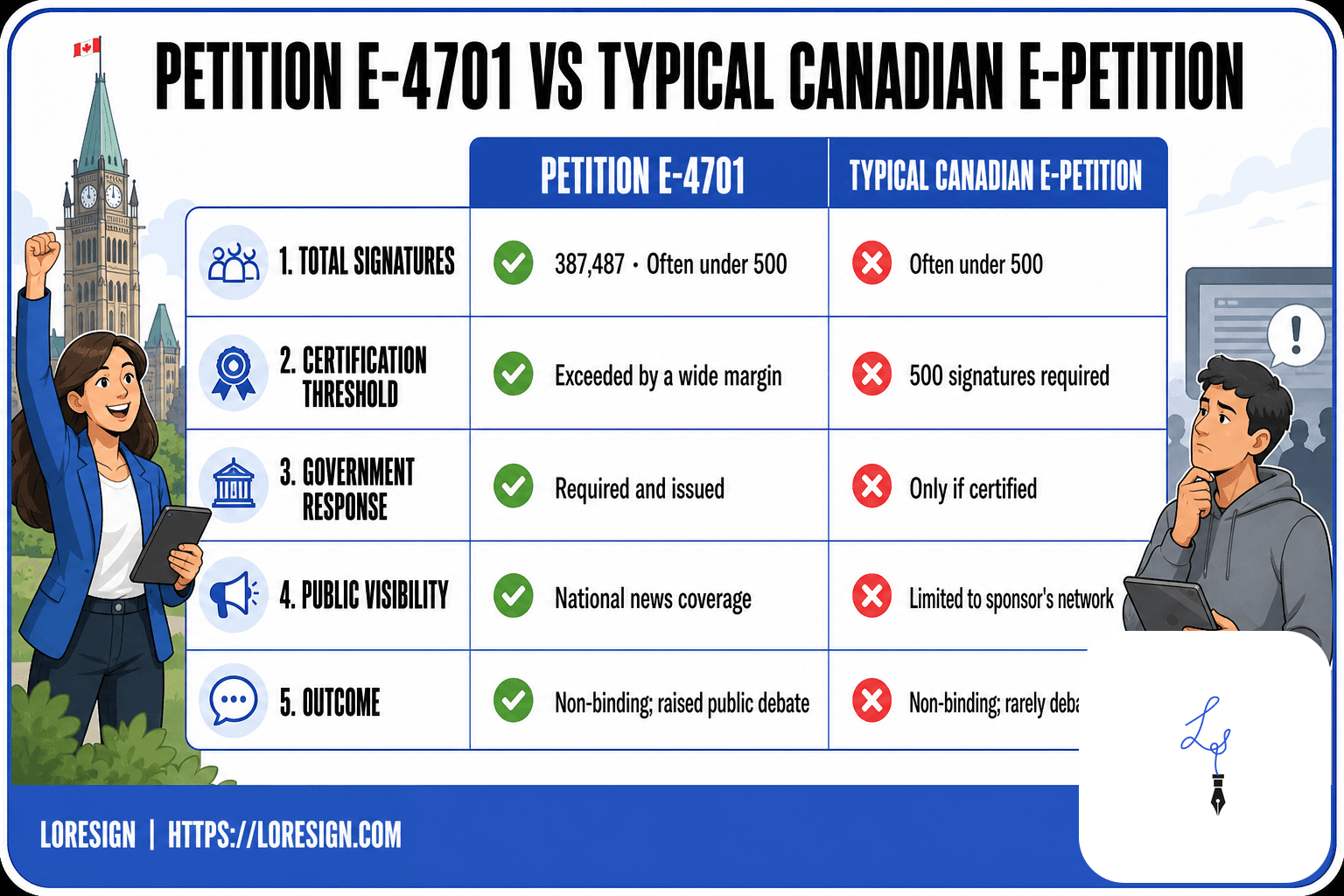
Petition e-4701 vs Typical Canadian E-Petition
| Factor | Petition e-4701 | Typical E-Petition |
|---|---|---|
| Total signatures | 387,487 | Often under 500 |
| Certification threshold | Exceeded by a wide margin | 500 signatures required |
| Government response | Required and issued | Only if certified |
| Public visibility | National news coverage | Limited to sponsor's network |
| Outcome | Non-binding; raised public debate | Non-binding; rarely debated |
What Makes 387,487 Signatures Significant?
The number matters because it's not just big. It's an outlier that breaks the scale of what Canadian e-petitions normally achieve. To understand why, you need to know what the system expects.
The 500-signature threshold for Canadian e-petitions
A Canadian e-petition needs 500 signatures to be certified and presented in the House of Commons. That's it. Five hundred verified signatures from Canadian residents gets your petition read aloud and forces a government response.
Most petitions clear that bar and stop. A few thousand signatures is a solid showing. Tens of thousands is exceptional.
387,487 is 775 times the threshold. The petition didn't just qualify. It collected more signatures in 120 days than most e-petitions collect in their entire existence, combined.
How e-4701 compares to typical e-petition signature counts
Here's the honest picture. Most Canadian e-petitions close with a few hundred to a few thousand signatures. A petition that reaches 10,000 signatures is considered highly successful. The House of Commons doesn't publish an official average, but browsing the closed petition archive shows most entries landing in the low thousands.
E-4701 didn't just beat the average. It beat the previous record by a wide margin. Before e-4701, the most-signed Canadian e-petition sat around 250,000 signatures. E-4701 added roughly 137,000 more on top of that.
Why this number broke records
The petition tapped into a specific, time-sensitive grievance. The capital gains inclusion rate change was announced in the 2024 federal budget, and it directly threatened a defined group: farmers, small business owners, and people with second properties or investments. That's a motivated base with clear financial stakes.
The 120-day window also created urgency. People who felt affected had a deadline, and deadlines drive action. The petition spread through farming communities, business associations, and financial advisors, not just general social media.
The result was a signature count that functioned as a referendum on a single policy. That's rare. Most e-petitions ask for broad changes and get broad, shallow support. E-4701 asked for something specific and got deep, concentrated support from people who stood to lose money.
That's what 387,487 signatures actually represents: not just public interest, but public alarm from a defined constituency.
[!tip] If you're organizing a petition or any document that needs signatures, use a tool that tracks every signer and automatically delivers the completed document once everyone has signed — LoreSign does this for PDFs, and you can upload any PDF, place signing fields, and send one secure link.
Petition E-4701 How Many Signatures: A Step-by-Step Guide
- Go to the official House of Commons e-petition website and create an account.
- Browse open petitions or search by keyword to find one you support.
- Click 'Sign' and provide your name, email, and postal code to verify your identity.
- Confirm your signature via the verification email sent to you.
- To start your own, draft a petition and find a Member of Parliament to sponsor it.
- Collect at least 500 signatures to meet the certification threshold.
- Submit the petition for certification; if certified, it is presented in the House of Commons.
How e-4701 Compares to Other Famous Petitions
387,487 signatures is a Canadian record. But records only mean something when you can see what they beat. Here's the comparison.
Most signed petition in Canadian history
E-4701 holds the top spot. Before it, the most-signed Canadian e-petition sat around 250,000 signatures. E-4701 cleared that by roughly 137,000.
The gap matters. Most record-breaking petitions edge past the previous holder by a few thousand signatures. E-4701 didn't edge. It lapped.
Keep in mind the comparison is only fair within the Canadian e-petition system. Paper petitions and provincial petitions track differently, and the House of Commons only started accepting e-petitions in 2015. So "most signed in Canadian history" means most signed since the system went digital. That's a real qualifier, not a footnote.
How e-4701 stacks up against global petition records
Globally, 387,487 is respectable but not record-setting. Change.org's largest petitions have crossed 5 million signatures. A UK Parliament petition about Brexit reached over 6 million. A 2020 petition on racial justice became one of the most-signed in Change.org's history at over 19 million.
So e-4701 is a Canadian record, not a global one. The honest answer is that Canada's population of 40 million caps what any domestic petition can achieve. A petition signed by 1% of the country is extraordinary here. The same percentage in the US would be 3.3 million signatures.
What record-breaking signature counts actually achieve
Here's the part most coverage skips. A record signature count gets you one thing: attention. It forces the government to respond, and it forces media to cover the response.
It does not force the government to agree.
E-4701's sponsor tabled the petition in the House of Commons, and the government issued a response. That response is a statement, not a policy change. The capital gains inclusion rate change went ahead regardless.
The record mattered because it made the government's refusal visible. That's the real function of a huge signature count: it raises the political cost of saying no. Whether that cost changes the outcome depends on the issue, the timing, and who's in power.
What Happens After a Petition Gets 387,487 Signatures?
The signatures are collected. The petition closes. Then the real process starts, and it's slower than most people expect.
The government response to e-4701
Once an e-petition closes, the sponsor (the MP who agreed to present it) tables it in the House of Commons. Tabling is a formal step: the petition becomes part of the parliamentary record. The government then has 45 calendar days to file a written response.
For e-4701, the government tabled a response. The response acknowledged the petition and explained the government's position on the capital gains inclusion rate. It did not reverse the policy.
That's the pattern for nearly every e-petition, regardless of signature count. The response is a document, not a commitment. It goes on the petition's official page on the House of Commons website, where anyone can read it.
What 'non-binding' really means
A Canadian e-petition is a request, not a demand. The government must respond, but it does not have to act.
Here's the mechanism. The House of Commons rules say the government has to table a response within 45 days. The rules say nothing about what that response must contain. A response can be a full policy explanation, a partial concession, or a polite refusal.
387,487 signatures raised the political cost of refusing. It did not create a legal obligation. The government could say no, and it did.
The honest answer is that e-petitions influence through visibility. They force a public, on-the-record answer. They don't force a particular answer.
Why the petition is now closed
E-petitions close when the parliamentary session ends or when the petition reaches its closing date, whichever comes first. Once closed, no new signatures can be added.
E-4701 is closed. The signature count is final at 387,487. The petition's page remains online as a public record, including the full signature breakdown by province and territory, the government response, and the petition's history.
That permanence is the point. A closed petition still works as evidence of public sentiment. It just can't grow anymore.
Can You Still Sign Petition e-4701?
No. The petition closed and the signature count is final at 387,487. You cannot add your name.
Session expiry: why e-petitions close
E-petitions live inside a parliamentary session. When that session ends, every open petition closes with it. E-4701 also hit its own closing date. Either way, the result is the same: the petition stops accepting signatures and the number freezes.
What to do if you wanted to sign e-4701
Nothing. There's no late-signing option, no appeal, no extension. The petition's page stays online as a public record, but the sign button is gone.
How to find open e-petitions to sign
Go to the House of Commons e-petitions portal. It lists every petition currently accepting signatures, with the closing date and current count for each. Sort by closing soon if you want to act before a petition expires.
How to Verify Petition Signature Counts
Don't trust a number just because someone posted it. Check it yourself. It takes two minutes.
Using the official House of Commons petition portal
Every Canadian e-petition lives on the House of Commons petitions portal. Search the petition number, e-4701, or the title. The details page shows the exact signature count, the sponsor's name, the opening and closing dates, and the full text of the petition.
The count on that page is the official number. No news article, social post, or third-party site overrides it. If a number doesn't match the portal, the portal wins.
Reading the province/territory signature breakdown
Each petition page includes a signature breakdown by province and territory. That table tells you where support came from, not just how much support existed. For e-4701, the breakdown shows which regions drove the count.
Check the breakdown when you want to know whether a petition has national reach or concentrated support in one region. A petition with 50,000 signatures from one province tells a different story than 50,000 spread across ten.
Red flags: how to spot inaccurate signature claims
Watch for rounded numbers. A claim like "nearly 400,000" is a paraphrase, not a count. The portal gives an exact figure.
Watch for missing dates. A signature count without an opening and closing date is useless because the number changes while a petition is open. If someone cites a count without saying when it was captured, check the portal yourself.
Watch for confusion between petitions. Similar titles exist. Always match the petition number, not just the subject line.
How to Start Your Own E-Petition in Canada
Starting an e-petition is straightforward, but the rules are strict. You need a Member of Parliament to sponsor it, and you need 500 signatures for the government to respond. That's the floor, not the goal.
The 500-signature threshold: what you need to know
Five hundred signatures is the minimum for a government response. Not for the petition to exist, not for it to be tabled. It's the number that forces the government to read it and reply in writing.
Most e-petitions never reach 500. The ones that do typically land between 500 and a few thousand. E-4701's 387,487 is an outlier by a factor of roughly a hundred. Don't plan around that number.
The threshold applies to verified signatures only. The portal checks each signer against the electoral roll. Fake names, duplicate entries, and people outside Canada don't count.
Finding a Member of Parliament to sponsor your petition
Any MP can sponsor a petition, but they don't have to. You're asking a sitting member to attach their name to your issue. That's a political decision for them.
Start with your own MP. Their office is the most likely to care about a constituent's request. If they decline, try MPs whose committee work or public statements align with your topic.
You need the sponsor before you submit. The petition portal won't accept a submission without one.
Step-by-step: submitting an e-petition
Draft the petition text. Keep it under 250 words, state the request clearly, and avoid demanding anything Parliament can't actually do.
Get your MP to agree to sponsor it. They'll review the text and submit it on your behalf through the House of Commons portal.
Wait for approval. The Clerk of Petitions checks the wording for compliance. If it passes, the petition goes live for 120 days.
Collect signatures. Share the link. Track the count on the portal.
If you hit 500, the petition gets tabled in the House and the government responds within 45 calendar days.
One practical note: if you're collecting signatures on any document, not just a parliamentary petition, you need a tool that tracks who signed and delivers the completed file. LoreSign handles that: upload the document, place the signing fields, send one link, and get the signed copy back automatically.
Common Mistakes When Petition e-4701 Signature Counts Are Discussed
The number gets thrown around a lot. Most of what people assume about it is wrong.
Myth: more signatures = guaranteed government action
387,487 signatures got e-4701 tabled in the House of Commons. It did not get the demand enacted. The government was required to respond in writing, which it did. That response can be a refusal, a partial concession, or a promise to study the issue further. Nothing in the e-petition system forces a vote, a law, or a policy change.
The signature count determines whether a response happens, not what the response says. A petition with 500 signatures gets the same procedural treatment as one with 387,487. The larger number adds political pressure, but pressure is not a mechanism. MPs can ignore it.
Myth: e-petitions are legally binding
They aren't. An e-petition is a request, not a referendum. Signing one does not create a legal obligation for Parliament or the government. The petition gets read, the government replies, and the matter ends there unless an MP chooses to pursue it through legislation.
This is different from signing a contract or a legal document, where your signature carries enforceable weight. A petition signature is an expression of support. Nothing more.
Myth: you can still sign e-4701
The petition closed when its 120-day window ended. The portal no longer accepts signatures, and there is no way to add your name retroactively. If you see a link claiming otherwise, it's outdated or fake.
The only way to support the issue now is to find an open petition on the same topic or contact your MP directly.
Petition e-4701: How Many Signatures Did It Get? The Bottom Line
Petition e-4701 collected 387,487 signatures, the most in Canadian e-petition history. That number cleared the 500-signature threshold by a factor of 775, forced a government response, and changed nothing about the policy it targeted. The petition is closed, the count is final, and the lesson for anyone collecting signatures is plain: a big number buys attention, not action. If you're running your own petition or sending documents for signature, track every signer and get the completed file back automatically. LoreSign does that with one secure link.
Frequently Asked Questions
How many signatures are on the petition?
Petition e-4701 received 387,487 signatures. This makes it the most-signed e-petition in Canadian history. The petition is now closed and no further signatures can be added.
What petition got the most signatures?
Petition e-4701 holds the record for the most signatures on a Canadian e-petition, with 387,487. It surpassed previous high-profile petitions, though exact totals for other petitions vary.
How many signatures does a petition need to be successful?
In the Canadian e-petition system, a petition needs at least 500 signatures to be certified and presented in the House of Commons. However, even a certified petition is non-binding, meaning the government is not legally required to act on it.
What is the most signed petition ever?
Worldwide, the most-signed petition depends on the platform and cause; some global petitions have gathered millions of signatures. In Canada, e-4701 is the record-holder for e-petitions.
Can I still sign petition e-4701?
No, petition e-4701 is closed. The signing period has ended, and no additional signatures can be accepted. You can look for other open petitions on the House of Commons website.
What happens after a petition gets enough signatures?
Once an e-petition is certified with at least 500 signatures, it is presented in the House of Commons. The government must respond within 45 days, but the response does not have to include any action.
How do I start my own petition?
To start a Canadian e-petition, you need to draft the petition text and find a Member of Parliament to sponsor it. Then you can publish it on the House of Commons website and collect signatures.
About LoreSign
LoreSign helps For people looking to get documents and contracts signed. get this right. Track every signer and receive the completed document automatically. Whether you are working through petition e-4701 how many signatures or something adjacent, we publish what we have actually tested, including where it falls short.