Intent to Sign: Why It Matters in a Contract and Best Practices
You sign a contract, skim the terms, and three months later a clause you never noticed costs you money or binds you to something you never meant. Are you stuck? The answer turns on a legal concept most signers never hear about: intent to sign. It's not the same as your signature, and it's not the same as saying "I agree." It's the state of mind and the circumstances that show whether you genuinely meant to be bound by the specific terms in front of you, and it's what courts look at when a contract falls apart.
A signature is evidence of intent, not a replacement for it. The good news is that intent is something you can protect before you ever pick up a pen or click a button, and tools like LoreSign can help by making the signing process more deliberate and the terms harder to skip past. This guide covers what intent to sign actually means, why it decides enforceability, the mistakes that undermine it, and a practical pre-signing checklist you can use today.
| At a glance | Details |
|---|---|
| Core idea | Intent to sign means you knowingly agree to be bound |
| Not the same as | A signature alone, or mere verbal agreement |
| When it matters | Disputes over whether a contract was formed |
| Who proves it | Usually the party seeking to enforce the contract |
| How it's shown | Conduct, context, and signing-process records |
| Practical takeaway | Read, ask questions, and keep a copy |
What Is Intent to Sign in a Contract?
Intent to sign is your deliberate, informed decision to be bound by the terms of a contract, shown by your signature or other clear action. It's not the ink on the page. It's the state of mind behind it: you understood what you were agreeing to, and you chose to agree anyway.
That distinction matters. A signature is evidence of intent. It is not intent itself. You can sign a document while confused, misled, or under pressure. The signature still exists. Whether the contract is enforceable is a separate question, and intent sits at the center of it.
Intent to sign vs. signature: what's the difference?
A signature is the physical or electronic mark you make. Intent is the mental act that gives the mark meaning.
Here's the practical difference. If you sign a contract because someone told you it was a receipt, your signature exists, but your intent to sign a contract does not. A court may set the contract aside. If you sign after reading every clause and asking questions, your intent is clear. The contract is far harder to challenge.
The signature is what the other party points to. Intent is what you bring to the table. Both matter, but only one is under your control before you sign.
How intent fits into "meeting of the minds"
Contract law requires mutual assent. Both sides have to agree to the same thing on the same terms. That's the "meeting of the minds."
Intent to sign is your half of that meeting. You can't have mutual assent if one party never intended to be bound. The law looks at what a reasonable person would understand from your words and actions, not what you privately thought. So intent is judged by what you did, not what you claim you meant later.
That's why courts look at the whole picture: did you negotiate terms, ask for changes, sign in the right place, and act as if the contract was in force afterward? Each of those actions is evidence of intent.
When intent is implied vs. explicit
Explicit intent is straightforward. You say "I agree" or you sign on the line. No ambiguity.
Implied intent is trickier. You don't sign anything, but your conduct shows you meant to be bound. You start performing under the contract. You accept the goods. You pay the invoice. A court may find you intended to accept the terms even without a signature.
The main catch is that implied intent is easier to dispute. The other party has to prove your conduct was clear enough to count as acceptance. Explicit intent, in the form of a signature, removes that argument. That's why written contracts remain the default for anything that matters.
Intent to sign is a legal concept about whether a person knowingly agreed to be bound, and it is separate from whether a signature looks valid. The exact test varies by jurisdiction, so treat this as general guidance rather than legal advice.
Intent to Sign vs. a Mere Signature: What's the Difference?
| Factor | Intent to Sign | Mere Signature |
|---|---|---|
| What it is | A conscious decision to be bound by the terms | A mark on a page, with or without understanding |
| Legal weight | Helps establish that a contract was formed | Evidence of assent, but not conclusive on its own |
| Typical proof | Conduct, communications, and signing-process records | The signed document itself |
| Common dispute | Whether the signer truly agreed to the terms | Whether the signature is genuine or authorised |
| Reader takeaway | Focus on understanding before you sign | Do not assume a signature alone settles everything |
Why Intent to Sign Matters for Contract Enforceability
A contract is only as strong as the intent behind it. When both sides clearly meant to be bound, courts enforce the deal. When intent is murky, the whole agreement can unravel. That's not a technicality. It's the difference between a contract you can rely on and a piece of paper that means nothing.
What happens when intent is unclear
If a court can't tell whether you meant to sign, it won't guess in the other party's favor. The contract may be voidable, meaning one side can walk away. Or it may be void from the start, meaning it never existed at all.
The burden usually falls on the person trying to enforce the contract. They have to show you understood the terms and chose to accept them. If they can't, the contract fails. That's why sloppy signing processes create real risk, not just awkwardness.
The role of intent in contract disputes
Most contract fights aren't about whether a signature exists. They're about what the signature meant. Did you sign the right version? Did you know about the clause on page seven? Did someone rush you through it?
Intent is the lens courts use to answer those questions. They look at what you did before signing, what you said during negotiations, and how you behaved afterward. A clean, deliberate signing process makes your intent hard to attack. A rushed one leaves it open.
Real-world examples of intent being challenged
Consider a freelancer who signs a client's contract without reading the payment terms. Later, the client pays 60 days late. The freelancer objects. The client points to the signature. The freelancer says they never intended to accept late payments. The court asks: did you have a chance to read it? Did you ask questions? If the answer is yes and yes, the freelancer loses. The signature plus the opportunity to understand equals intent.
Another example: someone signs a lease after the landlord verbally promises the rent includes utilities. The written lease says otherwise. The tenant's intent was to get utilities included. But the written terms control. The signature binds them to what's on the page, not what was said in the hallway.
The honest answer is that intent protects you only when you create evidence of it. Read the terms. Ask questions. Sign deliberately. That's the whole game.
If you are a small business owner signing a supplier or client contract, keep a short written record of the questions you asked and the answers you received before signing. That record can help show you signed with full understanding, which supports the intent-to-sign element if a dispute later arises.
Intent To Sign: A Step-by-Step Guide
- Read the entire document, including schedules, annexes, and any documents it refers to.
- Identify the parties, the subject matter, the payment terms, and the duration or termination conditions.
- Highlight any clause you do not understand, and look up unfamiliar legal terms in plain-language sources.
- Ask the other party to clarify or amend anything ambiguous, and get the answer in writing.
- Check for automatic renewal, exclusivity, penalty, or indemnity clauses that could affect you later.
- Confirm how you will sign, whether electronically or on paper, and whether witnesses or a notary are required.
- Save a complete copy of the final signed version, plus any correspondence about changes.
The Elements of a Valid Contract (and Where Intent Fits)
Every contract rests on five elements: offer, acceptance, consideration, capacity, and legality. Miss one and you don't have a contract, no matter how many signatures are on the page. Intent to sign isn't a sixth element. It's the thread running through all five.
Offer and acceptance: intent in action
An offer is one party saying, "Here are my terms." Acceptance is the other party saying, "I agree to those terms." Both require intent. A joke, a guess, or a hypothetical doesn't count as an offer because there's no intent to be bound. Same with acceptance. Signing the wrong version of a document, or signing under pressure, can undermine whether you truly accepted what was offered.
The signature is evidence of acceptance. But it's not acceptance itself. Courts look at whether you understood the offer and chose it freely. That's intent doing the work.
Consideration and capacity: what signers must understand
Consideration means each side gives something of value. Money for services. Goods for payment. A promise for a promise. You need to understand what you're giving and what you're getting. If you sign without knowing the price, your intent to accept that price is shaky.
Capacity means you're legally able to enter a contract. Minors, people under severe mental impairment, or someone signing under duress may lack capacity. Intent assumes capacity. You can't intend to agree to terms you're not capable of understanding.
How the three C's of a contract relate to intent
The three C's are consent, consideration, and capacity.
Consent is the big one for intent. It means both parties genuinely agreed to the same thing, freely and knowingly. Consideration is the exchange that makes it a contract rather than a gift. Capacity is the legal ability to consent in the first place.
Intent to sign is what makes consent real. Without it, you have a signature but no agreement. That's why the signing process matters as much as the signed document.
Common Contract Signing Mistakes That Undermine Intent
Most contract disputes don't start with a bad clause. They start with a careless signature. The mistakes below are common because they're easy to make, and each one gives the other party room to argue your intent wasn't what you now claim it was.
Signing without reading every clause
You've heard it before. You'll hear it again because it's the single most common mistake. Signing a contract you haven't read means you're agreeing to terms you don't know. Courts generally won't rescue you from that. The signature is treated as evidence you read and accepted everything above it.
The fix is boring but effective: read the whole document. Not skim. Not scan for the price and the dates. Every clause. If you don't have time, don't sign. A contract you can't read today is a contract you shouldn't sign today.
Ignoring definitions and cross-references
Contracts bury meaning in two places: the definitions section and cross-references to other clauses or schedules. A term like "Net Revenue" might sound simple, but the definition can subtract costs you didn't expect. A cross-reference to "Section 14.2" can import obligations you haven't seen.
When you hit a defined term, check the definition. When you hit a cross-reference, follow it. If the referenced section isn't in the document you're holding, ask for it before you sign. You can't intend to agree to terms you've never seen.
Using ambiguous or inconsistent signature formats
Your signature should match the name printed in the signature block. If the contract says "Jonathan A. Smith" and you sign "J. Smith," you've created a small ambiguity. Usually harmless. Sometimes not.
Inconsistent signatures across pages or documents can raise questions about who actually signed. Initials on one page, full signature on another, a different name on the cover page. Each mismatch is a thread the other side can pull if a dispute arises. Sign consistently. Use the name the contract uses for you.
Failing to date or initial key sections
An undated contract creates a timing question: when did this take effect? That matters for deadlines, payment terms, and termination windows. A missing date is an avoidable ambiguity.
Initials on key sections serve a different purpose. They show you saw and accepted specific clauses, especially unusual ones. If a contract asks you to initial next to an arbitration clause or a limitation of liability, don't skip it. Initialing doesn't change the terms. It records that you noticed them. That's intent, made visible.
The Red Hand Rule: What It Means for Unusual Contract Terms
Lord Denning's red hand rule says an unusual or onerous term needs to be flagged so clearly that it might as well be printed in red ink with a red hand pointing at it. If it's buried in fine print, a court may find it was never properly brought to the signer's attention, and it won't bind them.
Origin of the red hand rule
The rule comes from a 1956 English case, J Spurling Ltd v Bradshaw, where Lord Denning wrote that some clauses need to be "printed in red ink on the face of the document with a red hand pointing to it" before they can be enforced. The principle stuck. It's now a standard part of how courts think about unusual terms.
How it protects signers
The rule protects you from terms you couldn't reasonably expect. A parking ticket with a liability waiver on the back, a gym contract with a hidden auto-renewal, a software agreement with an arbitration clause buried on page 14. If the term is surprising and the other party didn't draw your eye to it, you may have grounds to argue it never became part of the deal.
What to do when you spot an unusual term
Don't sign yet. Ask the other party to explain it in writing. If they won't, that's a signal. A term someone won't explain is a term they know you wouldn't accept if you understood it. Initial it only after you understand it, and keep a copy showing how it was presented to you.
Best Practices for Intent to Sign: A Pre-Signing Checklist
The red hand rule protects you from terms that were hidden. It doesn't protect you from terms you skimmed. That's on you. The checklist below is the difference between signing with intent and signing on hope.
Read every clause — no exceptions
You read the parts you care about: price, dates, deliverables. The risk lives in the parts you skip. Indemnification, limitation of liability, termination, governing law. Read them. A clause you didn't read is still a clause you agreed to.
Ask for clarification on anything unclear
If a sentence takes two passes to parse, ask. "What does this mean in practice?" is a fair question. Get the answer in writing. A verbal explanation that contradicts the written term is worth nothing later.
Confirm all blanks are filled in
A blank line is an invitation. Someone fills it in later, and you've signed a contract with terms you never saw. Check every field: dates, amounts, names, addresses, payment terms. No blanks, no exceptions.
Verify names, dates, and amounts
Typos in a contract are not harmless. A wrong legal entity name can mean you've signed with the wrong party. A wrong date can shift an entire obligation. A wrong amount is a dispute waiting to happen. Check each one against the source document.
Consider the consequences of each obligation
Before you sign, ask what happens if you can't perform. What's the penalty? Who bears the cost of delay? What does termination actually require? If the answer is "I don't know," you're not ready to sign.
Keep a copy for your records
The signed contract is your evidence of what you agreed to. Store it somewhere you can find it in six months. A tool like LoreSign sends you the completed PDF automatically once everyone has signed, so you're not relying on the other party to forward it.
What You Cannot Do or Should Not Expect When Signing
The checklist helps you sign with clear intent. But intent has limits. Even a careful signer can't undo a bad deal by claiming they didn't mean it. Here's what the law won't do for you.
Ignorance is not a defense
You signed it. You're bound to it. That's the rule in most jurisdictions, and it holds even when you didn't read a single clause. Courts call it the duty to read. The contract is your notice of its own terms. If you had the chance to review it and signed anyway, saying "I didn't understand" rarely gets you out. The exception is narrow: fraud, duress, or a term so hidden that no reasonable person would expect it. Skimming isn't a legal category.
Verbal promises vs. written terms
The salesperson said the contract means X. The contract says Y. Y wins. Every time. Most written agreements include an integration clause, which says the document is the entire agreement. Any promise made before signing that isn't in the writing is gone. If a verbal commitment matters to you, get it into the contract. If the other side won't put it in writing, that's your answer about how much the promise is worth.
When courts will (and won't) intervene
Courts don't rescue people from bad bargains. You agreed to pay too much, accepted a lopsided termination clause, or waived a right you now regret. None of that is grounds to void the contract. Courts intervene when something went wrong with the formation itself: one party lied about a material fact, one party lacked capacity, or the terms are so one-sided they shock the conscience. That last one is a high bar. Most bad deals are just bad deals. You signed them. You keep them.
E-Signatures and Intent to Sign: What Changes (and What Doesn't)
An electronic signature doesn't change what intent means. It changes how you prove it. The legal standard is the same: you meant to sign, you understood what you were signing, and you agreed to be bound. What shifts is the evidence.
Are e-signatures legally binding?
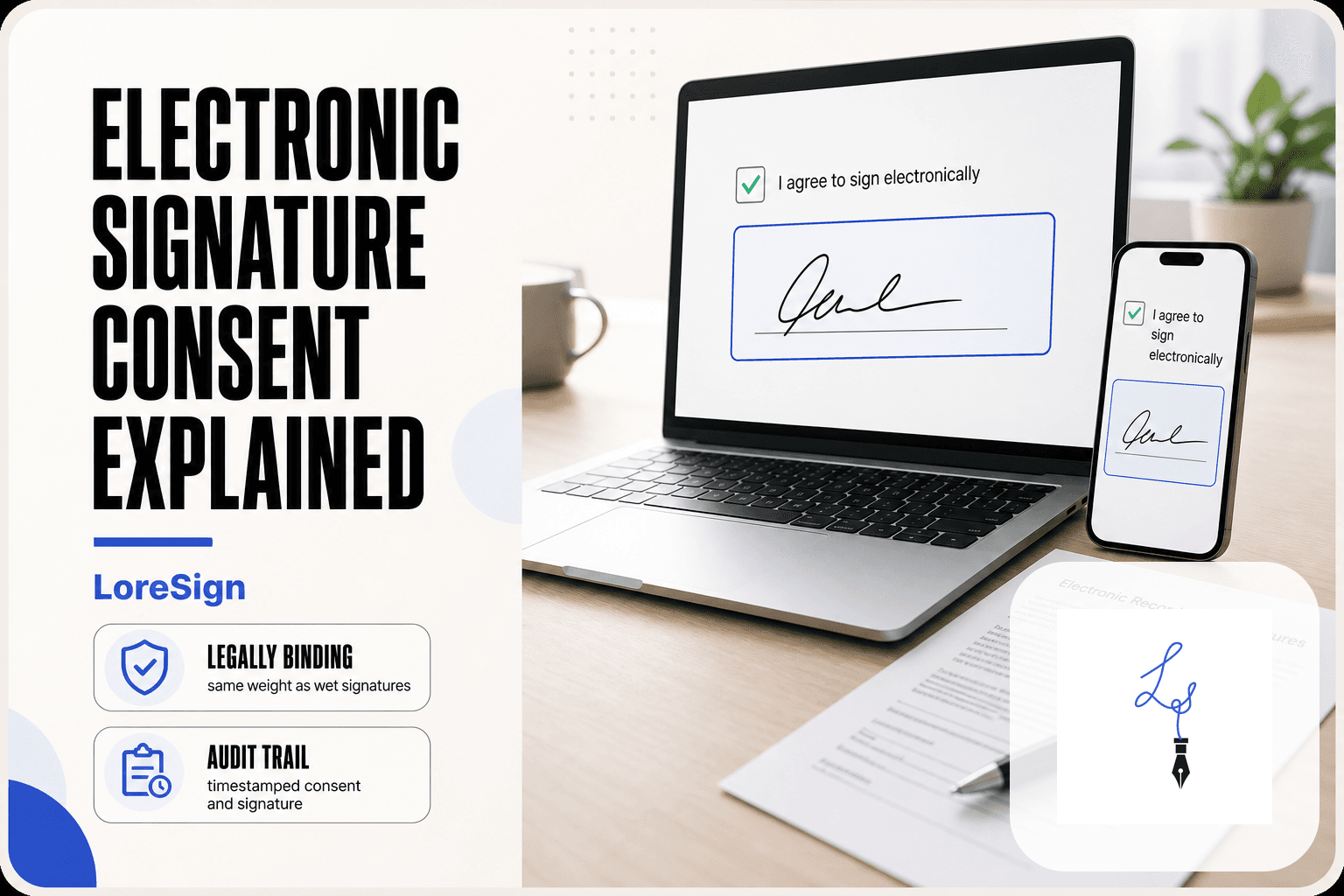
Yes. In most jurisdictions, e-signatures carry the same legal weight as wet ink. The U.S. ESIGN Act and the EU's eIDAS regulation both confirm this. The signature itself is not the contract. Your intent is. Clicking "I agree" or typing your name can bind you just as firmly as a pen.
How e-signature audit trails support intent
Here's what changes with e-signatures: the audit trail. A good e-signature tool records who signed, when they signed, and what they saw before signing. That timestamp and document hash make it harder to claim you never saw a clause. It also makes your intent easier to prove if a dispute arises. The trail is the evidence.
Choosing a signing tool that protects you
Look for a tool that shows you the full document before you sign, not just a signature box. LoreSign lets you upload any PDF, place signing fields, and send one secure link. You see the whole contract, not a fragment. That visibility protects your intent. A tool that hides terms behind a scroll bar doesn't.
Intent to sign is the difference between a signature that binds you and a signature that protects you. Create the evidence before you sign, and you won't have to argue about what you meant later.
Frequently Asked Questions
What is Lord Denning's red hand rule?
The red hand rule is a judicial comment by Lord Denning suggesting that particularly onerous or unusual clauses should be drawn to the other party's attention in a way that is unmistakable, as if printed in red ink with a red hand pointing to it. It reflects the idea that a signer should have a fair opportunity to notice unusual terms. The exact status of the rule varies across jurisdictions.
What are common contract signing mistakes?
Common mistakes include signing without reading the full document, ignoring schedules and referenced policies, failing to ask about unclear clauses, and not keeping a copy of the final version. Another frequent error is assuming that a verbal explanation overrides the written terms. Taking time to review and clarify before signing reduces these risks.
What are the three C's of a contract?
The three C's are often described as consent, consideration, and capacity. Consent means the parties genuinely agree, consideration means something of value is exchanged, and capacity means each party is legally able to contract. These elements overlap with the idea of intent to sign because consent depends on a knowing agreement.
What are the 7 rules of a contract?
Different sources list different rules, but commonly cited requirements include offer, acceptance, consideration, capacity, legality, intention to create legal relations, and certainty of terms. Some lists also include free consent and proper form where required. These are general principles, and the exact requirements depend on the applicable law.
What if you do not fully understand the contract, what should you do?
Ask the other party to explain the clause in plain language and, if needed, request a written amendment. If the stakes are high, consider getting advice from a qualified lawyer in your jurisdiction. Do not sign on the assumption that you can sort it out later, because the written terms usually govern.
Does signing electronically affect intent to sign?
Electronic signatures are generally treated as capable of expressing intent to sign, provided the signing process shows the signer's agreement. Many e-signature tools record who signed, when, and from where, which can help evidence intent. The legal effect still depends on the applicable e-signature law in your jurisdiction.
Can you be bound by a contract you did not read?
In many cases, yes, because a signature or other clear act of acceptance can indicate intent to be bound even if you did not read every clause. Exceptions can apply, for example where a clause is particularly unusual or where there was misrepresentation. Reading the document before signing remains the safest approach.
About LoreSign
LoreSign helps individuals and businesses create, send, sign, and track documents in one place. You can upload a PDF or create an agreement, add the required signing fields, send it to recipients, and automatically receive the completed document once everyone has signed.