Can E-Signatures Be Used on Prenuptial Agreements?
Yes, e-signatures can be used on prenuptial agreements in most US states, but engaged couples who sign one electronically are right to worry about one thing: a technicality that voids the whole agreement. The honest answer is that an e-signed prenup is only as strong as the process behind it. State law, notarization rules, and the audit trail all matter more than the signature itself. Most states have adopted the ESIGN Act and UETA, which give e-signatures the same legal weight as wet ink. But prenups sit in a special category because courts scrutinize them for duress, disclosure, and voluntary consent. LoreSign handles the mechanics: upload the PDF, place the signing fields, and send one secure link that tracks every signer and delivers the completed document automatically. This guide covers the state-by-state validity map, a risk matrix for when e-signatures are safe versus when wet ink is the only smart choice, and how to choose a platform that will not let your prenup fall apart in court.
| At a glance | Details |
|---|---|
| Short answer | Yes in most US states, with caveats |
| Governing laws | ESIGN Act and state UETA |
| Common exception | Wills, trusts and some family law |
| Notarization | Often required; remote online notarization varies |
| Biggest risk | Duress, disclosure and procedural defects |
| Best practice | Attorney review plus strong audit trail |
In This Guide
- What Is an E-Signature and Is It Legally Valid?
- E-Signed Prenup vs Wet-Ink Prenup: Which Holds Up Better?
- Are Prenups Eligible for E-Signatures?
- Can E Signatures Be Used On Prenuptial Agreements: A Step-by-Step Guide
- State-by-State E-Signature Validity for Prenups
- When E-Signatures May Not Be Ideal for a Prenup
- Risk Matrix: When E-Signatures Are Safe vs. Risky
- How to Safely Use E-Signatures on a Prenup
- Choosing an E-Signature Platform for Your Prenup
- Common Mistakes That Can Invalidate a Prenup
- What Legal Documents Cannot Be Signed Electronically?
- Can I Write My Own Prenup and Have It Notarized?
- Final Thoughts on E-Signing Your Prenup
What Is an E-Signature and Is It Legally Valid?
Yes. An e-signature is legally valid in the US, and it carries the same weight as a wet-ink signature when the law permits it.
Definition of an e-signature
An e-signature is any electronic mark that shows intent to sign. Typing your name, clicking "I agree," or drawing on a screen all count. It's not the same as a digital signature, which uses encryption.
The ESIGN Act and UETA explained
Two laws govern this. The ESIGN Act (2000) is federal. UETA is state-level, adopted by 47 states. Both say a contract can't be denied legal effect just because it's signed electronically.
The ESIGN Act and UETA generally validate electronic signatures, but they do not override state-specific formalities for prenups, such as notarization or witnessing. Always confirm your state's requirements before relying on an e-signed prenup.
E-Signed Prenup vs Wet-Ink Prenup: Which Holds Up Better?
| Factor | E-Signed Prenup | Wet-Ink Prenup |
|---|---|---|
| Legal recognition | Valid under ESIGN/UETA where adopted, subject to state family law | Traditionally accepted in all states |
| Notarization | Possible via remote online notarization where authorized; otherwise in-person | In-person notary straightforward |
| Evidence of signing | Timestamped audit trail and certificate of completion | Physical signatures; harder to prove timing |
| Convenience | Sign from anywhere; automated reminders and delivery | Requires coordination and physical copies |
| Risk of challenge | Higher if process is sloppy or notary rules ignored | Lower procedural risk, but still challengeable |
Are Prenups Eligible for E-Signatures?
Yes. Prenups are generally eligible for e-signatures under ESIGN and UETA, but state rules and notarization requirements can change that answer.
General eligibility under ESIGN and UETA
Neither federal law excludes prenuptial agreements. ESIGN and UETA cover contracts broadly, and a prenup is a contract. If your state has adopted UETA and doesn't impose extra formalities, an e-signed prenup is valid.
State law variations that affect eligibility
It depends on where you sign. Some states require prenups to be in writing and signed by both parties, but don't specify the signature method. Others add witnessing or notarization. A few states haven't adopted UETA at all, which pushes you to wet ink.
The notarization complication
Notarization is the main snag. If your state requires a notary, a standard e-signature alone won't satisfy it. You'll need remote online notarization, which not every platform supports.
For engaged couples, run a dry run of the signing flow with your attorney before the real signing. This catches notary or platform issues early and creates a clean record that both parties signed voluntarily.
Can E Signatures Be Used On Prenuptial Agreements: A Step-by-Step Guide
- Confirm your state allows electronic signatures for prenups and check notarization rules.
- Have a family law attorney draft or review the agreement before signing.
- Ensure both parties have full financial disclosure and time to review.
- Choose an e-signature platform that provides a certificate of completion and audit trail.
- Complete any required notarization, using remote online notarization only if your state permits it.
- Sign with ordered routing so each party signs in the correct sequence.
- Store the completed PDF and certificate of completion in a safe place.
State-by-State E-Signature Validity for Prenups
Most states have adopted UETA, but the details vary enough that you can't assume anything. Check your own state before you sign.
States that have adopted UETA
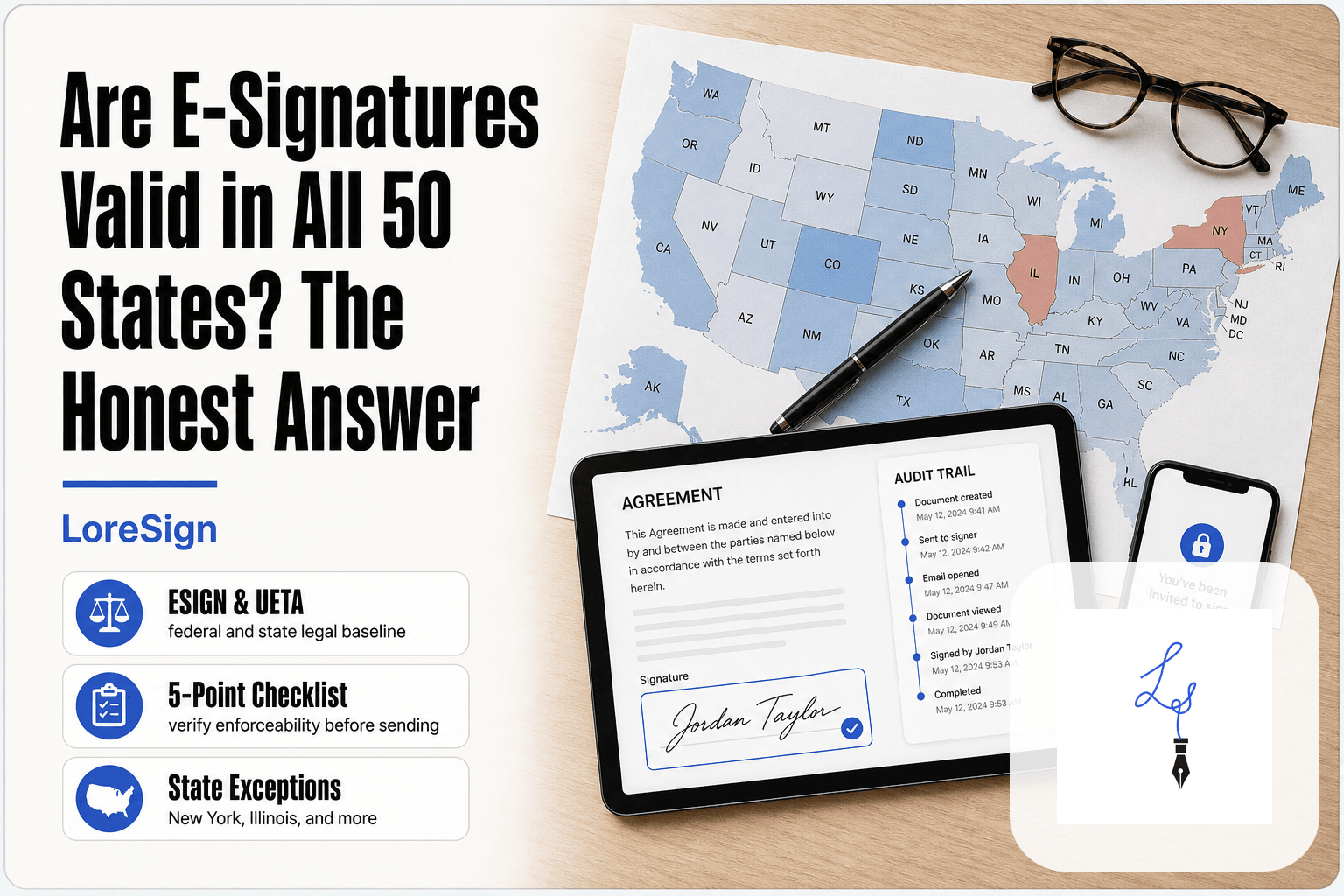
Forty-nine states plus DC have adopted UETA in some form. New York is the outlier: it has its own Electronic Signatures and Records Act, which is similar but not identical. Washington state adopted UETA but with modifications. The practical takeaway: e-signatures are recognized almost everywhere, but the statute's text differs slightly from state to state.
States with additional notarization or witnessing requirements
A handful of states impose extra formalities on prenups specifically. Some require notarization. Others require witnesses. A few require both. These requirements sit on top of UETA, so an e-signature alone won't satisfy them. You'll need remote online notarization or a wet-ink signing, depending on what your state demands.
How to verify your state's current rules
Don't rely on a blog post. Look up your state's version of UETA and your state's family law statutes on prenuptial agreements. A family law attorney in your state can confirm the current requirements in one call.
When E-Signatures May Not Be Ideal for a Prenup
E-signatures work for most prenups. They don't work for all of them. Here's where the process breaks down.
Notarization and witnessing requirements
If your state requires a notary or witnesses, a bare e-signature won't cut it. Remote online notarization can bridge the gap in many states, but not all. Check before you commit.
Court skepticism and challenge risk
A judge can scrutinize an e-signed prenup more closely if one party later claims duress or forgery. The audit trail matters. Weak authentication invites challenge.
When wet-ink is strongly advised
If either party has assets in a state with strict formalities, or if there's any history of coercion, sign in person. Wet ink removes one variable.
Risk Matrix: When E-Signatures Are Safe vs. Risky
Here's the decision tool. Match your situation to the row.
Safe scenarios for e-signing a prenup
Both parties have separate lawyers. Full financial disclosure is on record. Your state has adopted UETA without extra notarization rules. The platform logs IP addresses, timestamps, and two-factor authentication. No prior disputes between you.
Risky scenarios that require extra caution
One party signed without a lawyer. Disclosure was rushed or incomplete. Your state requires a notary and you skipped it. The platform's audit trail is thin. Either of you has a history of contested agreements.
Scenarios where wet-ink is strongly advised
Significant assets in a state with strict formalities. Any hint of coercion or pressure. A prior marriage ended in a contested prenup. One party is not tech-comfortable. Wet ink removes the authentication variable entirely.
How to Safely Use E-Signatures on a Prenup
The signature is the easy part. The process around it is what holds up in court.
Get independent legal advice first
Each of you needs your own lawyer. Not a shared one. A judge looks for evidence that both parties understood what they signed, and separate counsel is the strongest proof you have.
Ensure full financial disclosure
List every asset and debt. Incomplete disclosure is a faster way to lose a prenup than any signature format.
Document voluntary and informed consent
No pressure, no deadlines, no "just sign it tonight." Leave a gap between review and signing.
Choose a platform with strong audit trails
You want timestamps, IP logs, and two-factor authentication on record.
Store and retain signed copies securely
Keep the signed PDF, the certificate of completion, and the audit trail together. Both of you get copies.
Choosing an E-Signature Platform for Your Prenup
Not every platform is built for documents a judge will scrutinize. Look for three things.
Key features to look for: audit trails, authentication, compliance
An audit trail logs who signed, when, and from what IP. Authentication means two-factor verification, not just an email link. Compliance means the platform follows ESIGN and UETA standards. If a platform can't show all three, skip it.
Platform comparison: DocuSign, HelloSign, LoreSign, and others
DocuSign is the industry default, with strong audit trails and court-tested history. HelloSign (now Dropbox Sign) is simpler but lighter on authentication options. LoreSign tracks every signer, sends automated reminders, and delivers a certificate of completion plus a public verification page on every plan. The main catch: smaller platforms have less case law behind them.
Why audit trails matter for prenup enforceability
A prenup challenge usually turns on process, not signature format. If one party claims duress or forgery, the audit trail is your evidence. Timestamps, IP addresses, and verification steps show who signed and when. Without that record, you're arguing from memory.
Common Mistakes That Can Invalidate a Prenup
Most prenup challenges don't turn on the signature format. They turn on process failures a judge can see.
Duress or coercion
A prenup signed days before the wedding, or under pressure, invites a challenge. Courts look at timing and whether both parties had a real choice.
Incomplete financial disclosure
Hiding assets or debts is the fastest way to lose a prenup. Full disclosure is not optional.
Lack of independent legal advice
Each party needs their own lawyer. One shared attorney can sink the whole agreement.
Improper execution or notarization
Missing witnesses, skipped notarization, or sloppy e-signature records compound every risk above. The audit trail is your only proof the process was clean.
What Legal Documents Cannot Be Signed Electronically?
Wills, trusts, adoption papers, and certain court filings are the usual exclusions. Prenups are not on that list.
Documents typically excluded from e-signature
Wills and codicils top the list. Most states require wet ink and witnesses. Trusts, adoption consents, and some family law filings follow the same rule.
Why prenups are usually not excluded
Prenups are contracts, not testamentary documents. ESIGN and UETA cover contracts. That's the distinction.
State-specific exclusions to watch for
Some states add their own carve-outs. Check your state's UETA adoption and any family law statutes before you sign.
Can I Write My Own Prenup and Have It Notarized?
Yes, but notarization alone won't save a bad DIY draft. You can write your own prenup and have it notarized. A notary only verifies identity and signature, not fairness or enforceability.
DIY prenups: what's possible
You can draft one yourself. Courts scrutinize DIY prenups harder, especially when assets are uneven or one party waived counsel.
The role of notarization in enforceability
Notarization proves who signed and when. It doesn't prove voluntary consent, full disclosure, or independent legal advice. Those matter more.
Why notarization is not a substitute for legal advice
A notary isn't a lawyer. If a judge finds the agreement unconscionable or signed under pressure, the notary stamp won't fix it.
Final Thoughts on E-Signing Your Prenup
Can e-signatures be used on prenuptial agreements? In most states, yes. The ESIGN Act and UETA give electronic signatures the same legal weight as wet ink, and prenups aren't on the federal exclusion list. But "can" isn't the same as "will hold up."
Validity comes down to three things: your state's notarization rules, whether both parties signed voluntarily with full disclosure, and how well the platform captured the process. A sloppy e-signature with no audit trail invites a challenge. A clean one, with authentication and timestamps, is hard to attack.
LoreSign handles the process side: ordered multi-signer routing, automated reminders, a certificate of completion, and a public verification page. That's the paper trail a court wants to see. The legal advice part is still on you.
Frequently Asked Questions
What makes a prenup invalid?
A prenup can be invalid if it was signed under duress, without full financial disclosure, without independent counsel, or if it violates state law. Procedural defects like missing notarization or improper execution can also invalidate it.
What legal documents cannot be signed electronically?
Federal and state laws exclude certain documents, such as wills, codicils, trusts, and some family law documents. Prenups are not universally excluded, but state rules vary, so check your state's UETA exceptions.
What are common prenup mistakes?
Common mistakes include waiting until the last minute, hiding assets, failing to disclose finances, not using separate attorneys, and ignoring state-specific execution requirements like notarization.
Do prenups need to be notarized to be valid?
Notarization requirements vary by state. Some states require notarization, others require witnesses, and some require both. Check your state's specific rules for prenuptial agreements.
Is an e-signed prenup enforceable in court?
In many states, yes, if the electronic signature complies with ESIGN/UETA and all other state formalities are met. However, a court may still invalidate it for substantive reasons like duress or lack of disclosure.
Can we use remote online notarization for a prenup?
Remote online notarization is authorized in many states, but not all. Some states require in-person notarization for prenups. Verify your state's rules before scheduling a remote notarization.
About LoreSign
LoreSign helps For people looking to get documents and contracts signed. get this right. Track every signer and receive the completed document automatically. Whether you are working through can e signatures be used on prenuptial agreements or something adjacent, we publish what we have actually tested, including where it falls short.