Legal Risks of E-Signatures: A Practical Guide for Signers
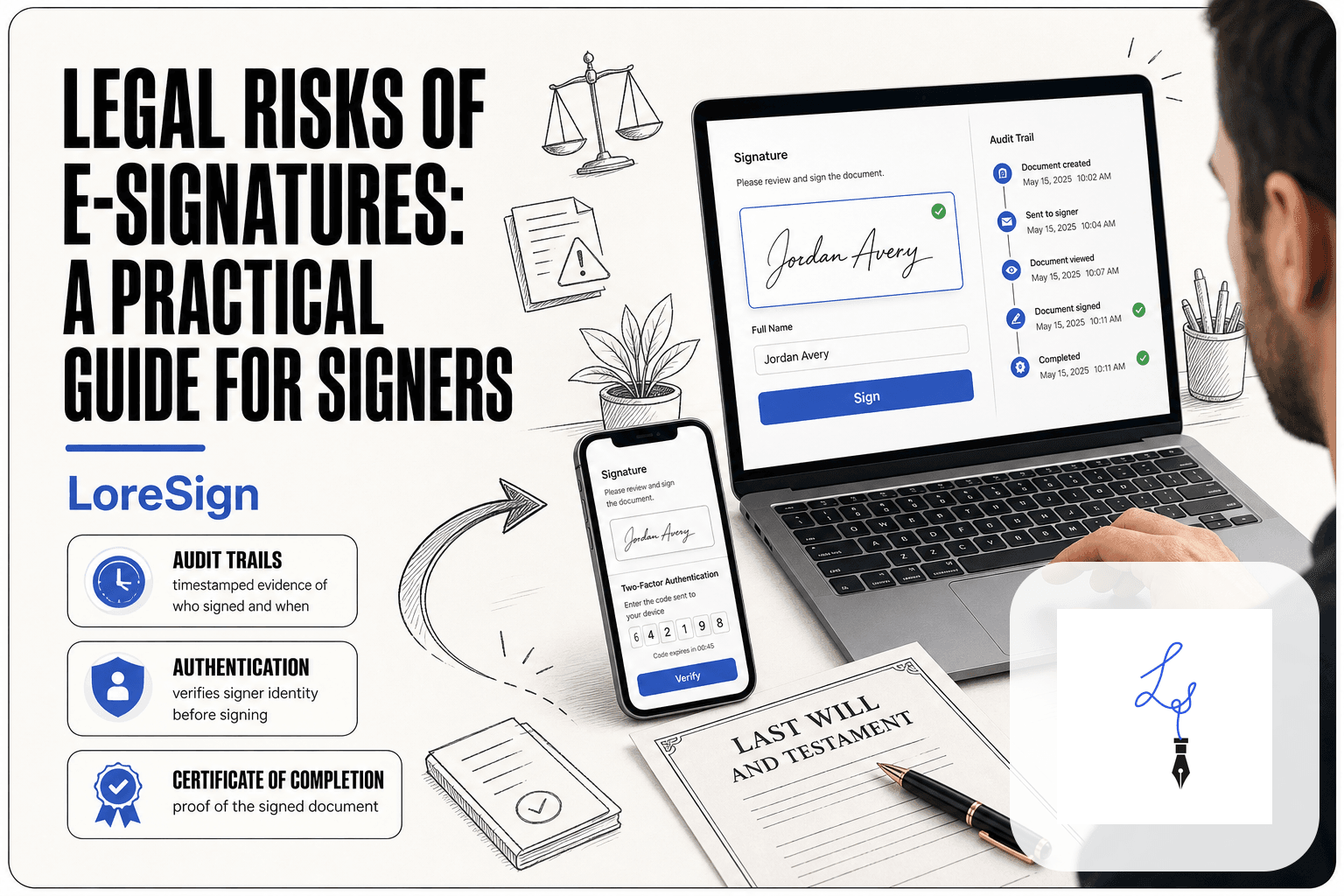
Legal risks of e signatures hit you about thirty seconds after you click "Sign" on a lease or a freelance contract. You're a US-based professional who just signed a binding agreement faster than you could order a coffee, and the thought lands: what did I actually just agree to, legally? The honest answer is that e-signatures are broadly legal in the US under the ESIGN Act and UETA, but "broadly legal" hides real exposure. Document exclusions. Authentication failures. Repudiation disputes. Outright fraud. Most e-signature vendors won't walk you through any of that before you sign. LoreSign reduces some of these risks with audit trails and authentication, but no tool makes e-signatures risk-free. This guide covers the document types you can't safely sign electronically, the court cases where e-signatures failed, and a practical checklist you can apply before, during, and after every signature.
| At a glance | Details |
|---|---|
| Federal validity | ESIGN Act and UETA make e-signatures enforceable |
| Main signer risk | Signing without reading or verifying identity |
| Main sender risk | Weak identity proof and incomplete audit trail |
| Excluded documents | Wills, trusts, some family and real estate papers |
| Strongest evidence | Certificate of completion plus full audit trail |
| Best protection | Read before signing and keep a copy |
In This Guide
- What Is an E-Signature?
- Signer Risks vs. Sender Risks in E-Signatures
- Are E-Signatures Legally Binding in the US?
- Legal Risks Of E Signatures: A Step-by-Step Guide
- The Real Legal Risks of E-Signatures
- What Legal Documents Cannot Be Signed Electronically?
- When NOT to Use E-Signatures
- How to Reduce Your Legal Exposure When E-Signing
- Common Misconceptions About E-Signature Legality
- Final Thoughts on Legal Risks of E-Signatures
What Is an E-Signature?
An e-signature is any electronic mark that shows a person's intent to agree to a document. It can be a typed name, a clicked "I agree" button, or a finger-drawn signature on a screen. The law treats it as the functional equivalent of a pen-and-ink signature, not a weaker substitute.
E-signature vs. digital signature: the key difference
People use these terms interchangeably. They aren't the same thing. An e-signature is the legal act of agreeing. A digital signature is a technical layer underneath: encryption that verifies the document hasn't been altered since signing. You can have an e-signature without a digital signature. Most e-signature platforms, including LoreSign, use both.
Common types of e-signatures (typed name, click-to-sign, drawn signature)
Typed name: you type your name into a field. Click-to-sign: you check a box or click a button stating you agree. Drawn signature: you draw your signature with a mouse or finger. All three carry the same legal weight under US law. The method doesn't matter. What matters is that you intended to sign.
[!note] The ESIGN Act and UETA establish baseline federal and state validity for e-signatures, but they do not override document-specific rules. Wills, trusts, and certain family law or real estate documents may still require wet-ink signatures or additional formalities under state law.
Signer Risks vs. Sender Risks in E-Signatures
| Factor | Signer Risks | Sender Risks |
|---|---|---|
| Identity exposure | Signature reused or forged without consent | Signer denies signing or claims someone else signed |
| Document control | Signing a document you did not fully read | Sending to wrong recipient or wrong version |
| Legal validity | Signing a document type that requires wet ink | Enforcing a contract that lacks proper consent |
| Evidence burden | Hard to prove you did not sign | Hard to prove who signed and when |
| Mitigation focus | Verify sender, read terms, keep copy | Verify identity, log audit trail, deliver certificate |
Are E-Signatures Legally Binding in the US?
Yes. E-signatures are legally binding in all 50 states under two federal laws: the ESIGN Act (2000) and the UETA, adopted by 49 states. A valid e-signature carries the same legal weight as a wet signature, provided the signer intended to sign and consented to doing so electronically.
The ESIGN Act and UETA: what they guarantee
The ESIGN Act and UETA guarantee that a signature can't be denied legal effect just because it's electronic. They also require that signers consent to electronic records and that the signature be attributable to the person signing. That last part matters more than most people think.
What "legally binding" does NOT mean
Legally binding doesn't mean automatically enforceable. It means a court will consider the signature valid evidence of intent. The other party can still challenge it. They can claim they didn't sign, didn't understand the terms, or that the document was altered after signing. The signature holds up only if you can prove who signed and what they agreed to.
State-by-state variations and exceptions
New York has its own statute, though it mirrors UETA closely. Illinois and Washington adopted UETA with modifications. The real variation isn't state law. It's document type. Wills, trusts, and some family law documents are excluded from e-signature validity in most states, regardless of what any platform claims.
[!tip] Before you click 'Sign,' check whether the platform provides a certificate of completion and an audit trail — these are the records that actually help you if a signature is later disputed. If the sender cannot show you that, ask for a different signing method.
Legal Risks Of E Signatures: A Step-by-Step Guide
- Confirm the document type is legally eligible for e-signature in your state.
- Verify the sender's identity through a known channel before opening any link.
- Read the full agreement, including any incorporated terms or attachments.
- Check that the signing platform logs timestamps, IP addresses, and signer identity.
- Sign only through a secure link and avoid forwarding it to anyone else.
- Download and store the completed PDF plus the certificate of completion.
- If a dispute arises, preserve the audit trail and any related correspondence.
The Real Legal Risks of E-Signatures
E-signatures are legally valid, but validity is not the same as safety. The risks sit in four places: proving who signed, stopping someone from denying it, meeting compliance rules, and preventing misuse of your signature.
Authentication risks: proving it was really you
Most e-signature platforms record an email address, an IP address, and a timestamp. That's it. If someone else has access to your email or device, they can sign as you, and the audit trail will point at you. A typed name or a pasted image of your signature proves nothing about identity. The mitigation is simple: use a platform that requires two-factor authentication or a unique signer link, and never sign from a shared device.
Repudiation risks: when the other party denies signing
The other party can claim they never signed, that their assistant clicked the link, or that the document changed after they saw it. If the platform's audit trail is thin, you're left arguing intent in court. The fix is an audit trail that records each step: who opened the document, when, from what IP, and what they clicked. Without that, a wet signature would actually be easier to defend.
Compliance risks: consent, disclosure, and record retention
ESIGN and UETA require that signers consent to electronic records and receive certain disclosures first. Many platforms bury this consent in a checkbox. If the consent wasn't clear, the signature can be challenged. Record retention matters too. If you can't produce the signed document and its audit trail years later, you can't enforce it.
Fraud and misuse risks: what someone can do with your signature
A stolen e-signature can authorize contracts, open accounts, or approve changes you never saw. The risk is higher than with wet signatures because there's no physical document to forge, just a link and a click. Use a platform with signer verification and never reuse a signer link. If you receive a document you didn't expect, don't sign it.
What Legal Documents Cannot Be Signed Electronically?
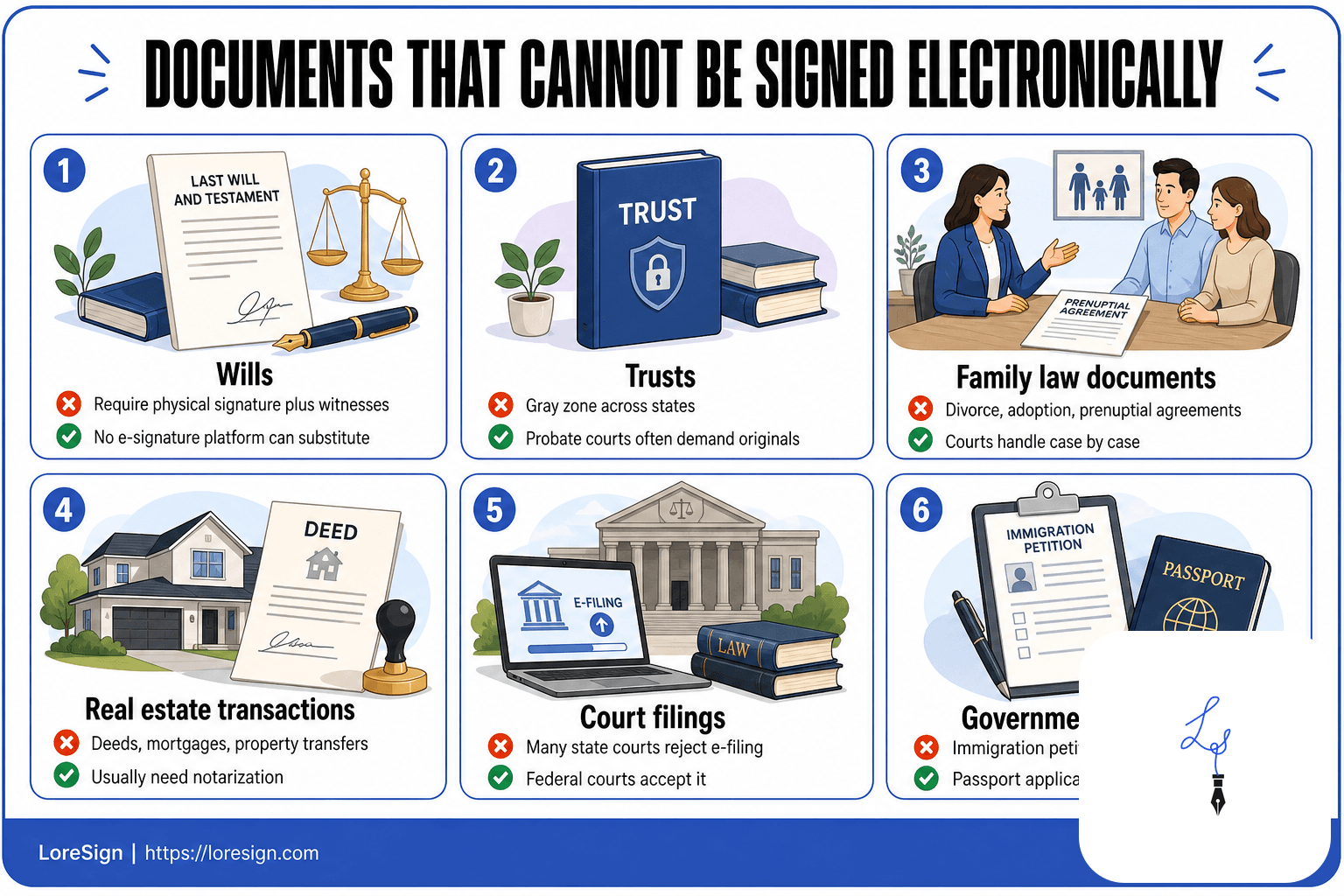
The ESIGN Act and UETA exclude certain document types outright. Others are technically e-signable but courts and agencies routinely reject them. When in doubt, insist on a wet signature.
Wills, trusts, and estate planning documents
Wills are the clearest exclusion. Most states require a physical signature plus witnesses, and no e-signature platform can substitute for that. Trusts sit in a gray zone: some states accept e-signed trusts, but probate courts often demand originals. If the document governs what happens after you die, sign it on paper.
Family law documents (divorce, adoption, prenuptial agreements)
Courts handle these case by case. A prenuptial agreement e-signed without independent legal review invites a challenge later. Adoption papers and divorce decrees require court filing, which means wet signatures in most jurisdictions. Don't risk it.
Real estate transactions and notarized documents
Deeds, mortgages, and property transfers usually need notarization. Remote online notarization exists in some states, but it's not universal. If your state doesn't authorize it, an e-signed deed is worthless.
Court filings and certain government forms
Federal courts accept e-filing, but many state courts don't. Government forms like immigration petitions or passport applications often demand original signatures. Check the specific agency before you click.
When NOT to Use E-Signatures
E-signatures are legal in most US transactions. That doesn't make them wise in every one. Some situations carry risk that no platform can remove.
High-value or high-dispute transactions
If the deal is worth more than you can afford to lose, get a wet signature. A disputed e-signature shifts the burden to you to prove who signed and when. That proof exists, but it costs time and money to produce. For a $500 freelance contract, fine. For a $500,000 asset sale, not worth it.
Cross-border agreements with unclear jurisdiction
ESIGN and UETA govern US transactions. The moment a counterparty sits in another country, you're guessing which law applies. Some countries don't recognize e-signatures at all. Others do, but with different authentication standards. If the contract doesn't specify governing law, don't e-sign it.
When the other party refuses to use a reputable platform
A signature is only as good as the platform behind it. If someone sends you a document through an unknown tool with no audit trail, you're signing blind. Insist on a platform that records timestamps, IP addresses, and authentication steps. No audit trail, no signature.
Documents requiring notarization or witnesses
Some documents need a notary or witness present. E-signature platforms can't conjure one. Remote online notarization exists in some states, but it's not universal. If the document requires a notary and your state doesn't allow remote notarization, you need paper.
How to Reduce Your Legal Exposure When E-Signing
You can't eliminate risk. You can shrink it. The steps below take minutes and cost nothing.
Before signing: verify identity and read the full document
Check who sent the document. A legitimate contract comes from a known email address, not a lookalike domain. If you weren't expecting it, call the sender.
Read every page. Not skim. E-signature platforms let you scroll past clauses in seconds, and that's exactly how people agree to terms they never saw. If the document is long, download it and read offline.
During signing: use a platform with audit trails and authentication
The platform matters more than the signature itself. You want one that records timestamps, IP addresses, email verification, and each step of the signing process. That audit trail is your evidence if the other party later denies signing.
Two-factor authentication adds a second layer. A password alone won't prove it was you. A code sent to your phone will.
After signing: save copies and confirm receipt
Download the signed PDF immediately. Don't rely on the platform to keep it forever. Store it somewhere you control.
Confirm the other party received the completed document. Most platforms send an automatic notification. If yours doesn't, email a copy yourself and keep that email.
Red flags that should make you pause
Pressure to sign immediately. A blank or partially filled document. A sender who won't identify themselves. A platform you've never heard of with no visible security features. Any of these is reason to stop.
The honest answer is that most e-signature risk comes from rushing. Slow down, verify, and keep your own records. That covers most of what can go wrong.
Common Misconceptions About E-Signature Legality
Most confusion about e-signatures comes from treating them as a new, untested thing. They're not. They've been legally binding in the US for over two decades.
Myth: E-signatures are less enforceable than wet signatures
The ESIGN Act and UETA put e-signatures on equal footing with ink. A court won't reject a contract just because you clicked instead of signed. What matters is whether you actually agreed, and whether the other side can prove it.
Myth: E-signatures are easy to forge
A typed name is easy to copy. A proper e-signature isn't. Reputable platforms log IP addresses, timestamps, email verification, and sometimes two-factor authentication. Forging that chain of evidence is harder than copying a pen stroke.
Myth: You can revoke an e-signature anytime
Once you sign, you're bound unless the contract itself allows withdrawal. There's no universal "undo" button. Some laws give cooling-off periods for specific transactions, but that's the exception, not the rule.
Final Thoughts on Legal Risks of E-Signatures
E-signatures are broadly safe. The legal risks of e signatures aren't in the technology itself. They're in the situations: excluded documents, weak authentication, and disputes where you can't prove who signed.
The honest answer is that most signers will never face a problem. But when a contract goes wrong, the evidence trail decides the outcome. Use a platform that logs timestamps, IP addresses, and identity checks. Save your copies.
LoreSign builds that audit trail automatically: ordered multi-signer routing, a certificate of completion, and a public verification page on every plan. It won't fix a will or a court filing, and it won't stop someone from lying. It just makes the truth easier to prove.
Frequently Asked Questions
What are the legal risks of such e-signatures?
The main risks are identity fraud, signing without full understanding of the terms, and using e-signatures on document types that legally require wet ink. For senders, the risks include inability to prove who signed and when. Most of these risks are manageable with proper verification and record-keeping.
Do e-signatures hold up in court?
Yes, e-signatures are generally enforceable in US courts under the ESIGN Act and UETA. Courts look at whether the signer intended to sign and whether the record is reliable. A clear audit trail and certificate of completion strengthen enforceability.
Can someone do anything with my signature?
A copied or forged signature can be misused, but a proper e-signature platform ties each signature to a verified identity and logs the event. If you suspect misuse, report it immediately and preserve the audit trail. Using unique credentials and not sharing signing links reduces this risk.
What legal documents cannot be signed electronically?
Wills, trusts, and certain family law documents such as divorce or adoption papers often cannot be e-signed. Some states also restrict e-signatures for specific real estate documents. Always check your state's rules before signing.
Is an e-signature legally binding if I did not read the document?
Yes, in most cases. Courts generally hold signers to the terms they signed, whether or not they read them. Reading the full agreement before signing is one of the simplest ways to reduce your legal exposure.
How can I prove I did not sign a document?
You can challenge the signature by showing the audit trail does not match your usual behavior, or that your credentials were compromised. Platforms that log IP addresses, timestamps, and device information make this easier. Report suspected forgery promptly.
What should a sender do to reduce e-signature legal risk?
Senders should verify signer identity, use ordered multi-signer routing where appropriate, enable automated reminders, and retain the certificate of completion and audit trail. Sending the completed signed PDF automatically also creates a clear record for both parties.
About LoreSign
LoreSign helps For people looking to get documents and contracts signed. get this right. Track every signer and receive the completed document automatically. Whether you are working through legal risks of e signatures or something adjacent, we publish what we have actually tested, including where it falls short.