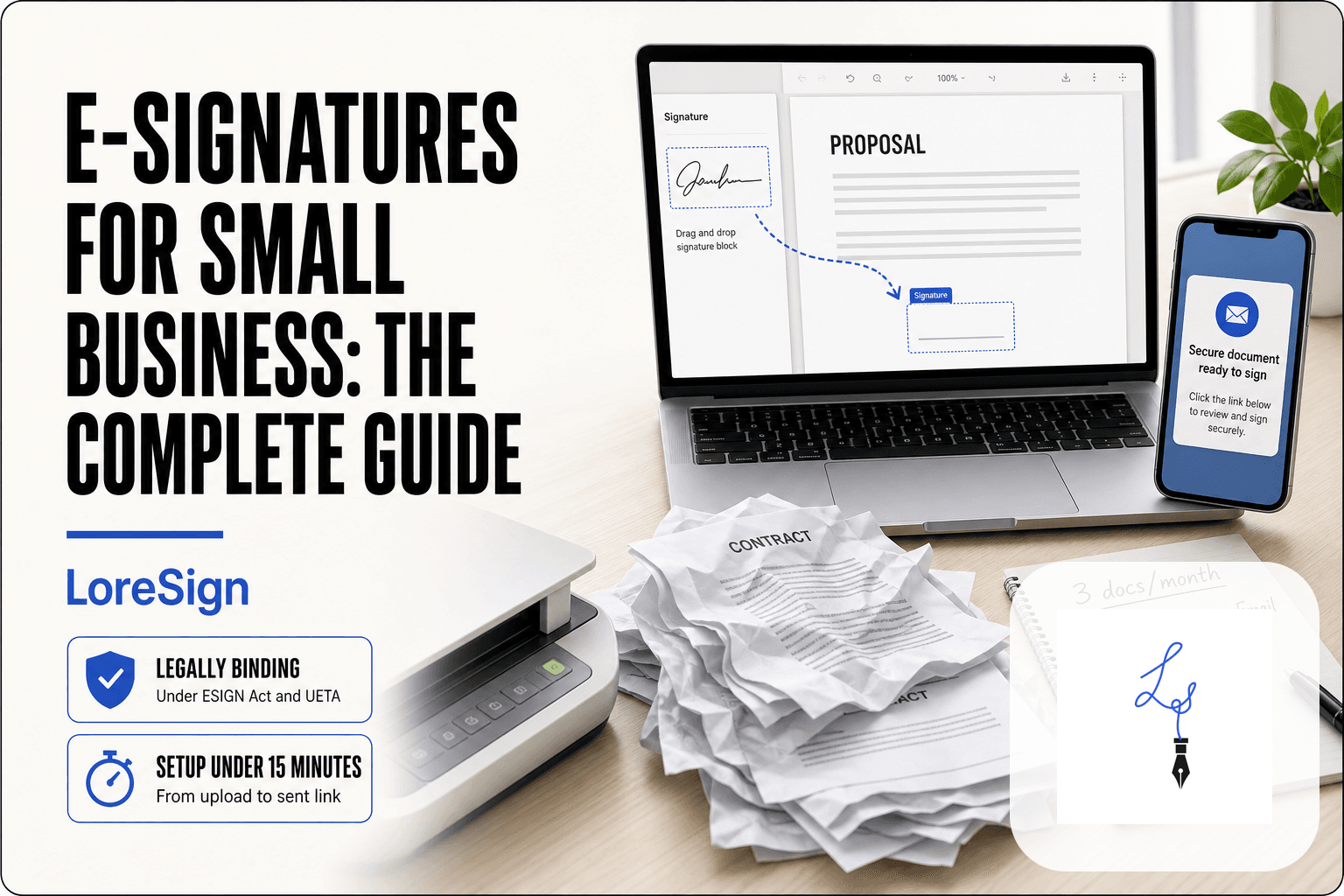
Digital Signature Guidelines for E-Governance: What You Need to Know
Guidelines for usage of digital signatures in e-governance are not something most U.S. small business owners read for fun. You have a contract sitting in your inbox, a deadline, and one question: will this electronic signature hold up if someone challenges it later? The official answer lives across four frameworks: ESIGN, UETA, NIST, and FDA rules. Each one is dense, written for lawyers or agency staff, and vendor blogs only tell you their tool is great. This guide translates what the guidelines actually say into plain language, including what they won't do for you. LoreSign handles the compliance mechanics behind the scenes, but you still need to know which rules apply to your document.
| At a glance | Details |
|---|---|
| Main U.S. laws | ESIGN Act and UETA govern e-signatures |
| Federal technical standard | NIST FIPS 186-5 for digital signatures |
| FDA records | 21 CFR Part 11 covers electronic records |
| Core validity test | Intent, consent, attribution, and record retention |
| What it can't do | Cannot replace wills, court orders, or some filings |
| Best practice | Keep an audit trail and a certificate of completion |
In This Guide
- What Are Digital Signatures and How Do They Differ from Electronic Signatures?
- Electronic Signature vs Digital Signature: What's the Difference?
- U.S. Legal Framework: ESIGN, UETA, and State-Level Variations
- Guidelines For Usage Of Digital Signatures In E-governance: A Step-by-Step Guide
- NIST Standards for Digital Signatures: FIPS 186 and SP 800-89
- FDA Guidelines for Electronic Signatures: 21 CFR Part 11
- The Four Requirements for a Valid Electronic Signature
- Common Mistakes When Following Digital Signature Guidelines
- How to Choose a Compliant Signing Solution for Documents and Contracts
- Limitations: What Digital Signatures Cannot Do
- Final Thoughts on Digital Signature Guidelines for E-Governance
What Are Digital Signatures and How Do They Differ from Electronic Signatures?
A digital signature is a cryptographic technique that proves a document hasn't been altered and links it to a specific signer. An electronic signature is the broader legal concept covering any electronic indication of intent to sign, including a typed name or a checked box.
The two terms get used interchangeably, but they aren't the same thing. Most people signing a contract don't need a digital signature at all. They need an electronic signature that satisfies the law.
Electronic signatures: the legal umbrella
An electronic signature is any electronic sound, symbol, or process attached to a record that shows intent to sign. Typing your name, clicking an "I agree" button, or drawing your signature on a touchscreen all count. The law doesn't care about the technology. It cares about intent, consent, attribution, and record retention.
Digital signatures: the cryptographic subset
A digital signature is a specific technology underneath some electronic signatures. It uses public key infrastructure (PKI) to create a unique, tamper-evident seal. When you sign, the system generates a cryptographic hash of the document and encrypts it with your private key. Anyone can verify it with your public key. If the document changes after signing, the verification fails.
Why the distinction matters for compliance
Most U.S. guidelines for e-governance and business documents require an electronic signature, not a digital one. ESIGN and UETA don't mandate cryptography. They mandate evidence of intent and consent. Digital signatures matter when a regulation specifically requires them, like certain FDA submissions or high-security government transactions. For everyday contracts, a compliant e-signature platform with an audit trail is enough.
The ESIGN Act and UETA set the legal baseline for electronic signatures in the U.S., but they do not override document-specific rules certain wills, court documents, and some agency filings still require wet signatures or a specific digital certificate.
Electronic Signature vs Digital Signature: What's the Difference?
| Factor | Electronic Signature | Digital Signature |
|---|---|---|
| Definition | Any electronic mark showing intent to sign | A cryptographic signature using a certificate |
| Common standard | ESIGN Act, UETA | NIST FIPS 186-5, PKI |
| Typical use | Contracts, leases, HR forms | Government filings, software, regulated records |
| Verification | Audit trail and signer identity checks | Certificate-based validation and tamper detection |
| Legal weight | Legally binding when requirements are met | Legally binding and technically verifiable |
U.S. Legal Framework: ESIGN, UETA, and State-Level Variations
Two laws govern electronic signatures in the U.S. The Electronic Signatures in Global and National Commerce Act (ESIGN) sets the federal baseline. The Uniform Electronic Transactions Act (UETA) is the state-level standard. Both say the same core thing: an electronic signature can't be denied legal effect just because it's electronic.
The ESIGN Act: federal baseline
ESIGN passed in 2000. It applies to interstate and foreign commerce. The law says a signature, contract, or record can't be rejected solely because it's in electronic form. It also requires that consumers consent to doing business electronically before a transaction proceeds. That consent must be demonstrable, not assumed.
UETA: the state-level standard
UETA is a model law adopted by 47 states, the District of Columbia, Puerto Rico, and the U.S. Virgin Islands. It covers intrastate transactions. The three holdouts are New York, Illinois, and Washington, but each passed its own electronic signature statute that mirrors UETA closely. In practice, the rules are nearly identical everywhere.
What happens when state laws conflict with federal rules
ESIGN preempts state law, with one exception. If a state adopted UETA exactly as written, that version controls. If a state modified UETA in a way that conflicts with ESIGN, federal law wins. For most signers this distinction never matters. The requirements for validity are the same under both.
Documents that may still require wet signatures
ESIGN and UETA exclude certain documents. Court orders, notices of eviction, foreclosure, utility shutoff, and health insurance cancellation generally require paper. Wills, trusts, and adoption papers also fall outside. Check your state's specific list before assuming a document can be e-signed.
If you sign contracts regularly, turn on automated reminders and ordered multi-signer routing so each signer gets the document in the right sequence — this reduces back-and-forth and keeps your audit trail clean.
Guidelines For Usage Of Digital Signatures In E-governance: A Step-by-Step Guide
- Confirm the signer clearly intends to sign and consents to doing business electronically.
- Check that the solution captures who signed, when, and from what device or IP address.
- Verify the signed record can be retained and reproduced accurately by all parties.
- Look for an audit trail or certificate of completion that ties each signature to the document.
- Match the tool to your document type — regulated records may need a certificate-based digital signature.
- Test the recipient experience before sending a real contract to a client or agency.
NIST Standards for Digital Signatures: FIPS 186 and SP 800-89
NIST is the National Institute of Standards and Technology, a U.S. federal agency that publishes technical standards. Its digital signature standards matter because they define what "secure" actually means at the cryptographic level. If a signing tool says it's secure, NIST standards are usually the yardstick.
What FIPS 186 covers: signature algorithms
FIPS 186 specifies which mathematical algorithms are approved for generating and verifying digital signatures. The current version, FIPS 186-5, approves three families: RSA, ECDSA, and EdDSA. Each works differently, but all three produce a signature that can be checked against the signer's public key. If a document was signed with an algorithm outside this list, it may still be valid, but it won't meet federal security requirements.
What SP 800-89 covers: key management
SP 800-89 is a companion guide. It covers how to handle the cryptographic keys that make signatures work: how long keys should be, when to rotate them, and what to do when a key is compromised. The document is aimed at system administrators, not signers. You won't need to read it unless you're building or auditing a signing system.
Do you need to understand NIST standards to sign a document?
No. NIST standards govern how signing software works under the hood. They don't impose requirements on the person clicking "sign." What matters for you is whether your signing tool uses compliant algorithms and manages keys properly. Most reputable e-signature platforms do. You can check a vendor's security documentation if you want confirmation, but you won't be tested on FIPS 186 to sign a lease.
FDA Guidelines for Electronic Signatures: 21 CFR Part 11
21 CFR Part 11 is the FDA's rule for electronic records and electronic signatures. It applies to companies that submit records to the FDA or maintain records the FDA can inspect. If you're signing a lease or a freelance contract, this rule doesn't touch you. If you work in pharma, biotech, medical devices, or food manufacturing, it likely does.
Who needs to comply with 21 CFR Part 11
The rule covers any organization whose electronic records fall under an FDA regulation. That includes drug makers, medical device manufacturers, clinical trial sponsors, and certain food and cosmetics companies. It also applies to their suppliers and contract labs when those records support an FDA submission. A hospital signing patient consent forms generally isn't covered unless the form ties to a clinical trial the FDA oversees.
Key requirements: audit trails, validation, and record retention
Part 11 has three main pillars. Audit trails must record who signed, when, and what they signed, and the trail must be secure and unalterable. Validation means the company has to prove its e-signature system works as intended, with documented testing. Record retention requires keeping electronic records accessible and readable for as long as the underlying regulation demands, which can be years. The signature must also be unique to one person and cannot be reused by anyone else.
How to check if your signing solution is Part 11 compliant
Ask the vendor directly. Most e-signature platforms publish a compliance statement or will provide one on request. What you're looking for: tamper-evident audit trails, unique signer authentication, and the ability to export records in a format the FDA can read. A vendor saying "we're secure" isn't enough. You need written confirmation that the system meets Part 11 requirements, and you need to keep that documentation for your own audits.
The Four Requirements for a Valid Electronic Signature
A valid electronic signature isn't just a typed name or a pasted image. It has to satisfy four legal requirements: intent to sign, consent to do business electronically, attribution to the signer, and record retention. Miss any one of them and the signature can be challenged.
Intent to sign: showing clear agreement
Intent means the signer actually meant to sign. Clicking a button labeled "I agree" or "Sign" is enough. Typing your name at the bottom of an email can count, but it's weaker because it's harder to prove you meant it as a signature. Most e-signature platforms handle this by making the action explicit: you see the document, you click a sign button, and the system records that action. The key is that the signer's action is clear and deliberate, not accidental.
Consent to do business electronically
Consent means the signer agreed to use electronic signatures in the first place. Under ESIGN, a business must get a consumer's consent before sending documents electronically. In practice, this is usually a checkbox or a "continue" button that says something like "I agree to sign electronically." For business-to-business deals, consent is often implied by the fact that both parties are using an e-signature platform. But for consumer transactions, you need affirmative consent, and you should keep a record of it.
Attribution: proving who signed
Attribution means you can connect the signature to a specific person. An email address alone is weak attribution. A unique login with a password is stronger. Two-factor authentication is stronger still. The signing platform should record the signer's email, IP address, and timestamp, and ideally tie the signature to a verified identity. If someone later claims "I didn't sign that," the attribution evidence is what settles the dispute.
Record retention: keeping the evidence
The signed document and its audit trail have to be stored somewhere accessible. ESIGN requires that electronic records be retained in a form that can be accurately reproduced for later reference. That means you can't just rely on a screenshot. You need the actual signed PDF plus the certificate of completion, the audit log, and any consent records. Most platforms store these automatically. If you're self-hosting, you're responsible for keeping them readable for as long as the underlying contract or regulation requires.
Common Mistakes When Following Digital Signature Guidelines
Most signing mistakes aren't technical. They're assumptions. People assume the law is uniform, assume every document qualifies, assume the tool they picked is compliant. Here are the four that cause the most trouble.
Assuming every document can be e-signed
Some documents still need a wet signature. Court filings in certain jurisdictions, wills, trusts, adoption papers, and some real estate deeds fall outside ESIGN and UETA coverage. Check before you send. If the other party requires a notary, an electronic signature alone won't satisfy them.
Ignoring state-level variations
ESIGN sets a federal floor, but states can add requirements. Illinois, New York, and Washington have their own electronic signature statutes with specific rules. A workflow that's valid in Texas might not hold up in a New York court. If you sign across state lines, check both states.
Using a tool without an audit trail
A signature without an audit trail is just a picture. If the platform doesn't record who signed, when, from what IP address, and what they clicked, you can't prove attribution later. Free tools often skip this. You'll find out when the contract is challenged.
Failing to retain records properly
The signed PDF isn't enough. You need the certificate of completion, the audit log, and the consent record stored together. Screenshots don't count. If you delete the platform account or the vendor goes under, you lose the evidence. Download and back up everything.
How to Choose a Compliant Signing Solution for Documents and Contracts
You've read the guidelines. Now you need a tool that actually follows them. Most signing platforms say they're compliant. Few explain what that means. Here's a checklist you can run against any option in about ten minutes.
Check for ESIGN and UETA compliance
Start with the legal baseline. The platform should state plainly that it complies with ESIGN and UETA. If it doesn't mention either law, that's a red flag. Ask for the consent and attribution mechanism: how does the tool prove the signer agreed to sign electronically, and how does it tie the signature to a specific person?
A compliant tool records intent and consent before the signature is applied. It doesn't just drop a signature image onto a PDF. If the vendor can't explain how consent is captured, move on.
Verify security features: encryption, audit trails, and authentication
The technical layer matters just as much. You need three things. Encryption in transit and at rest, so the document can't be intercepted or altered. An audit trail that logs every action: who opened it, when, what they clicked, what IP address they used. And authentication that proves the signer is who they claim to be, typically email verification plus a unique signing link.
Without all three, you have a convenience tool, not a signing solution. The audit trail is the one people skip most often. Don't.
Evaluate ease of use for all parties
A compliant tool that confuses your signers creates its own problems. The person on the other end shouldn't need to create an account, download software, or read a manual. They should receive a link, open it, and sign.
Test this yourself. Send a document to a non-technical friend. If they can't complete it in under two minutes, your contracts will stall. The best compliance features mean nothing if signers abandon the process.
Consider industry-specific requirements (FDA, state rules)
If you're in pharma, medical devices, or any FDA-regulated space, check for 21 CFR Part 11 compliance explicitly. Don't assume. Ask the vendor for documentation. State rules vary too: Illinois, New York, and Washington have their own statutes. A tool that handles federal compliance may still need configuration for state-specific workflows.
LoreSign covers the baseline: ESIGN and UETA compliance, audit trails, encryption, and a public verification page on every plan. It also handles ordered multi-signer routing, which matters when contracts need signatures in sequence. But it's not the only option. Run any tool through this checklist before you commit.
Limitations: What Digital Signatures Cannot Do
Digital signatures solve a lot. They don't solve everything. Here's what you can't expect them to handle.
Documents that still require wet signatures
Some documents need ink. Court filings in certain jurisdictions, wills, trusts, and some family law documents like adoption papers or divorce decrees often require a physical signature. Real estate transfers can be tricky too: some counties accept e-signatures for deeds, others don't. Check with the specific court or agency before you assume.
Jurisdictions with limited e-signature acceptance
ESIGN and UETA cover the U.S., but not every country follows the same rules. If you're signing with someone overseas, their local law may not recognize your electronic signature. Some countries require specific local digital certificate authorities. Others don't accept foreign e-signatures at all. For cross-border contracts, confirm acceptance in both jurisdictions first.
Technical limitations: what a digital signature does not prove
A digital signature proves who signed and that the document wasn't altered after signing. It doesn't prove the signer read the document. It doesn't prove they understood it. It doesn't prove they weren't coerced. Those are legal questions a court decides, not something cryptography can answer.
Final Thoughts on Digital Signature Guidelines for E-Governance
The guidelines covered here come down to a few practical points. Use a signing solution that captures intent, consent, attribution, and a tamper-evident record. Check whether your document type falls under ESIGN, UETA, or industry rules like 21 CFR Part 11. Keep the audit trail and the signed copy somewhere you can retrieve them years later.
Digital signatures are legally valid when you follow those guidelines. The law doesn't require you to understand cryptography. It requires you to be able to show who signed, what they agreed to, and that nothing changed afterward.
The honest answer is that most signing workflows don't need to be complicated. A compliant tool like LoreSign handles the audit trail, the certificate of completion, and the automatic delivery of the signed PDF without you managing any of it. You still need to check your document type and your jurisdiction. The tool can't do that part for you. And that's the part that matters most when someone challenges a signature: the guidelines for usage of digital signatures in e-governance only protect you if you followed them.
Frequently Asked Questions
What are the regulations for digital signatures?
In the U.S., the ESIGN Act and the Uniform Electronic Transactions Act (UETA) provide the legal framework for electronic signatures. Technical standards like NIST FIPS 186-5 apply to certificate-based digital signatures, and sector rules such as FDA 21 CFR Part 11 apply to regulated records. State-level versions of UETA may add specific requirements.
What is the NIST standard for digital signatures?
NIST publishes FIPS 186-5, which specifies approved digital signature algorithms such as RSA and ECDSA. It is a technical standard used by government agencies and vendors that need certificate-based signatures. It is not a legal requirement for most everyday contracts.
What are the FDA guidelines for electronic signatures?
FDA 21 CFR Part 11 sets requirements for electronic records and signatures in regulated industries like pharmaceuticals and medical devices. It covers things like signer identity verification, audit trails, and record retention. If your documents fall under FDA rules, you need a system that meets those specific controls.
What are the four requirements for an electronic signature to be valid?
Most U.S. guidelines point to four elements: the signer must intend to sign, must consent to electronic records, the signature must be attributable to the signer, and the record must be retainable and reproducible. Meeting these four generally satisfies ESIGN and UETA.
Are digital signatures legally binding in the U.S.?
Yes, electronic signatures are legally binding in the U.S. when they meet ESIGN and UETA requirements. Digital signatures using certificates add technical verification but are not required for most contracts. Some documents, like wills or certain court filings, may still need a wet signature.
What should I look for in a compliant e-signature tool?
Look for a clear audit trail, certificate of completion, signer authentication options, and the ability to retain and reproduce the signed document. If you work in a regulated field, check whether the tool supports the specific standard that applies to you.
Can I use an electronic signature for government forms?
Many federal and state agencies accept electronic signatures for forms and filings, but acceptance varies by agency and form type. Check the specific agency's instructions before signing. When in doubt, a certificate-based digital signature may be required.
About LoreSign
LoreSign helps For people looking to get documents and contracts signed. get this right. Track every signer and receive the completed document automatically. Whether you are working through guidelines for usage of digital signatures in e-governance or something adjacent, we publish what we have actually tested, including where it falls short.